Why is this difficult?
Struggling to find the right key for your favorite songs? Transposing guitar chords can be a game changer, making songs easier to play and better suited to your voice.
The Smart Solution
With our tool, you can easily transpose guitar chords to match your vocal range or simplify difficult chord shapes. Say goodbye to frustration and hello to playing music that feels just right!
- Instant chord transposition for any song
- User-friendly interface for musicians of all levels
- Support for multiple instruments and tunings
- Save and share your transposed chords with ease
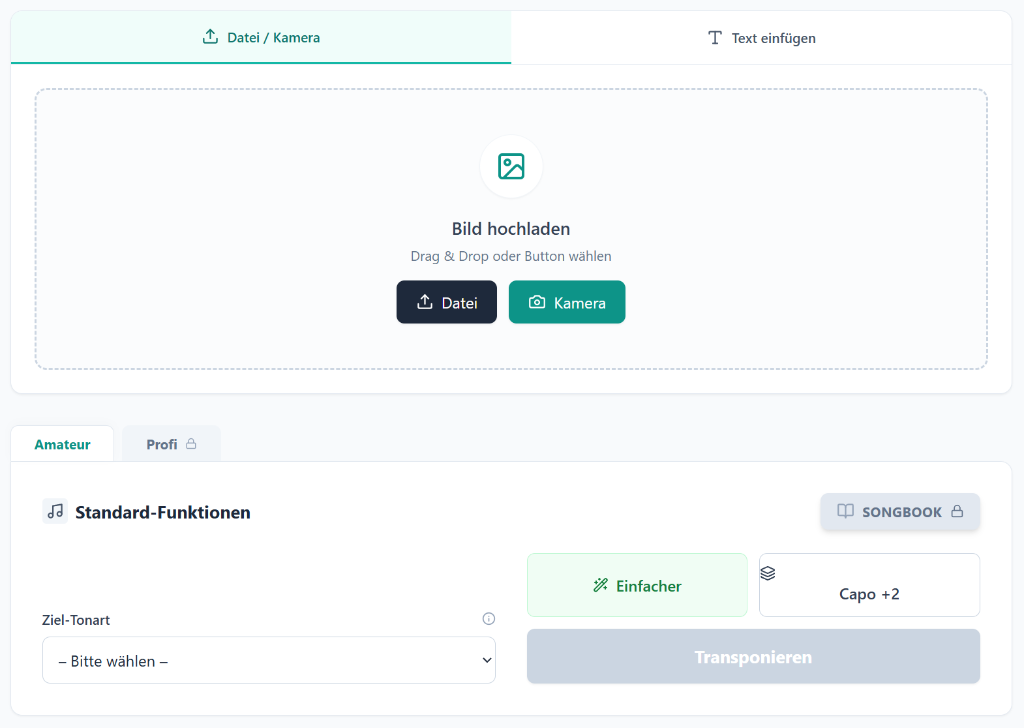
Quick and Easy Chord Transposition
Transpose guitar chords online in seconds! Whether a song is too high for your voice or the chords are too challenging, our tool helps you find the perfect key effortlessly.
Advanced Theory & Insights
Deepened knowledge for professionals. Analyzing nuances that beginners often miss.
The Mathematical Foundation of Transposing Guitar Chords
Transposing Chord Voicings for Enhanced Guitar Techniques
The Role of Transposition in Jazz and Improvisation
FAQ
?
How does understanding the relationships between different chord voicings assist a guitarist when transposing chords across various keys?
?
Why might a guitarist choose to transpose a song even if it is within their vocal range, and what are the potential musical benefits of doing so?
A guitarist might choose to **transpose a song** even if it sits comfortably within their vocal range for several compelling reasons. Firstly, **different keys can influence the overall emotion or feel** of a song. Certain keys might resonate better with the artist's intended expression or fit the mood they aim to convey, enhancing the **emotional impact** of the performance.
Moreover, transposing can make the song more accessible for accompanying instruments or other vocalists. If a **band or ensemble** is involved, changing the key may allow better harmonization or balance across different instruments. Additionally, during live performances, guitarists may need to adjust the key of songs quickly based on the venue’s acoustics or audience engagement, ensuring the best possible sound.
Transposing can also provide **technical benefits**. Altering the key can sometimes highlight different aspects of a guitarist’s skills or lead to a more comfortable fingering or position on the fretboard. For instance, some keys may offer easier chord shapes or allow for **creative improvisation** possibilities during solos.
In conclusion, taking the time to **experiment with different keys** through transposition can significantly enhance both the performance and listening experience, leading to a more engaging and expressive interpretation of any song.
?
In what ways can the process of transposing guitar chords enhance a musician's improvisational skills during live performances?
**Transposing guitar chords** can significantly enhance a musician's improvisational skills, particularly during live performances, by expanding their musical versatility and adaptability. Firstly, **understanding chord progressions** in various keys allows musicians to play songs in different tonalities, accommodating various vocal ranges and collaborating effectively with other musicians.
Moreover, **the process of transposing promotes deeper musicianship**. When guitarists shift chords to new keys, it encourages them to explore the fretboard more thoroughly, enhancing their familiarity with chord shapes and finger placements. This practice not only aids in memorization but also ignites creativity, urging musicians to experiment with unique voicings and rhythmic variations.
For actionable advice, musicians should regularly incorporate transposition into their practice routine. Start with simple songs and gradually move to complex progressions. Use a **capo or practice a specific chord shape** in different positions on the neck to increase fluency. Additionally, **jamming with other musicians** in varying keys can simulate live performance conditions, building confidence and spontaneity in improvisation. By mastering the art of transposing chords, guitarists can significantly enhance their performance and improvisational capabilities.
?
How does the key signature influence the complexity of transposing guitar chords, particularly when dealing with intricate chord progressions?
The **key signature** plays a crucial role in the complexity of transposing guitar chords, particularly with intricate chord progressions. Understanding the relationship between keys is essential for guitarists looking to maintain the harmonic integrity of their songs.
When you transpose, each chord in a progression must be shifted up or down by the same interval. Chords that contain **sharp** or **flat** notes can complicate this process. For example, transposing from a key with five sharps (B major) to one with two flats (B♭ major) involves several alterations, increasing the potential for mistakes. In contrast, simpler keys, like C major or A minor, feature fewer accidentals which makes transposition more straightforward.
To mitigate complexity, **familiarize yourself with common chord shapes** in various keys. Practice transposing simple progressions before tackling more intricate ones. Use **capos** to help shift keys while maintaining familiar fingerings, which can ease the learning curve and facilitate smoother transitions. Additionally, leveraging transposition tools or software can assist in harmonically accurate transpositions, especially for challenging progressions. Consistent practice will enhance both your muscle memory and theoretical understanding of chord relationships, thereby simplifying future transpositions.
?
What role does ear training play in a guitarist's ability to transpose chords quickly and effectively, and how can this skill affect overall musicality?
Ear training plays a crucial role in a guitarist's ability to transpose chords quickly and effectively. By developing a trained ear, guitarists can identify chord qualities, relationships, and functions within a key. When musicians can hear and recognize chords accurately, they can transpose them without needing to rely solely on sheet music or tablature. This skill enhances their adaptability and confidence in various musical settings, whether playing with a band, jamming with friends, or performing live.
Moreover, good ear training helps guitarists understand musical structure and progressions. By grasping how chords work together, musicians can easily shift songs to different keys, allowing for easier singing or fitting in with different instruments. Transposing becomes less of a technical task and more of an intuitive process when one can hear the relationships between notes and chords.
To improve your ear training, practice interval recognition, chord identification, and singing back melodies. Regularly transcribing songs by ear can also greatly help. Start with simple pieces, then gradually progress to more complex arrangements. As you enhance your ear, you will find that your overall musicality and ability to interact musically with others will significantly improve.