Why is this difficult?
Are you struggling to find the right key for your favorite songs? Whether the chords are too complex or the key doesn’t match your vocal range, it can be frustrating.
The Smart Solution
Our Online chord transposition tool simplifies this process, allowing you to change the key of any song in seconds. Just input your chords, select the desired key, and get instant results tailored to your needs.
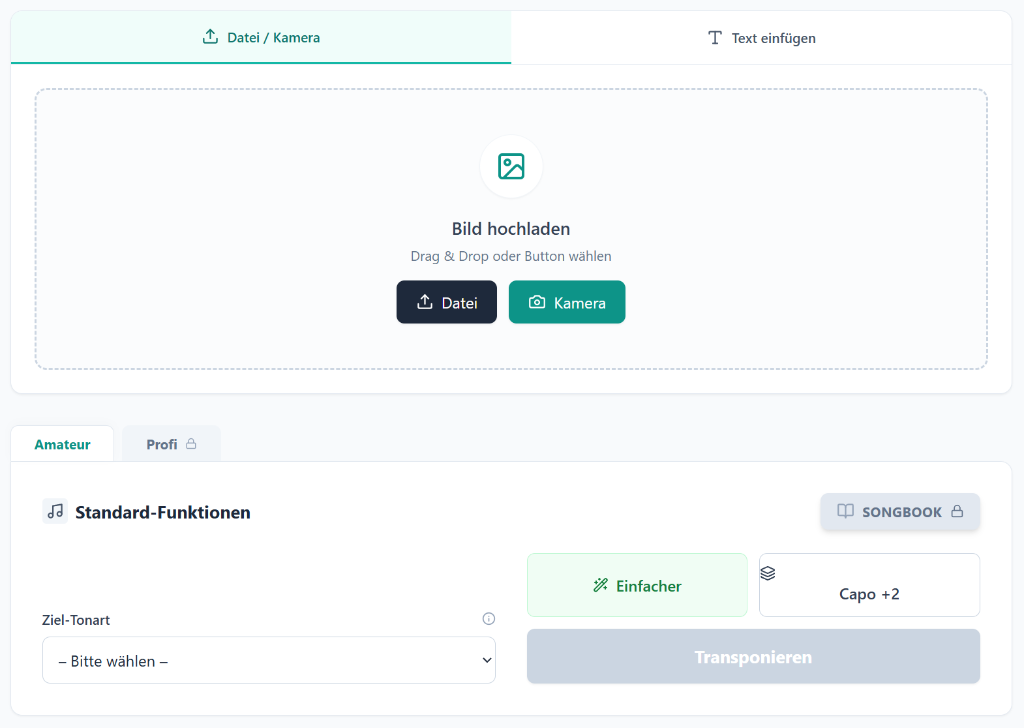
Transpose Your Chords Online with Ease
With our Online chord transposition tool, you can easily adjust the key of your songs to match your vocal range or playing style. No matter your proficiency, just input your chords and find the perfect fit in moments.
Advanced Theory & Insights
Deepened knowledge for professionals. Analyzing nuances that beginners often miss.
The Mathematics of Chord Transposition
The Role of Enharmonic Equivalence in Transposition
The Impact of Transposition on Songwriting and Arrangement
FAQ
?
How do online chord transposition tools utilize algorithms to ensure accuracy in changing keys, and what challenges might they face in maintaining harmonic integrity during this process?
Online chord transposition tools leverage complex **algorithms** to accurately change the key of a piece of music. These tools typically start by analyzing the **chord structure** and identifying the root notes of each chord. Once the original key is determined, the algorithm translates each chord to its corresponding chord in the target key by applying a calculated **interval shift**. This ensures that every chord retains its relative position and function within the harmonic framework.
However, **maintaining harmonic integrity** during this transposition process presents challenges. For instance, certain chords may involve alterations or extensions that could be lost or misrepresented when moved to a different key, potentially leading to less recognizable sound or unintended dissonance. Additionally, algorithms must account for specific **voicings and inversions** that musicians may prefer, ensuring that the essence of the music is preserved.
To enhance accuracy, users should consider offering feedback on the results, as this can help refine the algorithms over time. It’s also advisable to cross-check transposed chords with musical theory knowledge to maintain **musical coherence**, especially with more complex compositions. Regular updates and user-testing of the tool can further improve its effectiveness in achieving harmonious results.
?
Why is it important for online chord transposition tools to accommodate various musical genres and styles, and how can the design of these tools reflect the unique characteristics of different music types?
It is crucial for online chord transposition tools to accommodate **various musical genres and styles** due to the diverse harmonic structures and conventions that exist within different types of music. For example, jazz typically employs extended chords and complex progressions, while pop music often relies on straightforward triads. By catering to a wide array of genres, these tools empower users to seamlessly adapt songs to fit their specific musical context, ensuring they can play or perform effectively.
The design of these tools should **reflect the unique characteristics** of different music types. This can be achieved by incorporating features such as genre-specific chord suggestions, integrated backing tracks, or visually distinctive interfaces that emulate the aesthetic of a particular genre. For instance, a jazz-focused tool could offer advanced chord voicings and substitutions, while a folk-oriented platform might prioritize simplicity and open voicings.
Moreover, **allowing user customization**—such as saving favorite transpositions, sharing with the community, or selecting alternate tuning options—can significantly enhance usability across genres. In summary, embracing the diversity of music styles not only broadens the tool’s appeal but also enriches the user experience, enabling musicians to engage more deeply with the music they love.
?
In what ways can user feedback and preferences shape the development and features of online chord transposition tools, and how might this iterative design process improve user experience?
User feedback and preferences play a crucial role in the development of online chord transposition tools. By actively gathering insights through surveys, user testing, and feedback forms, developers can identify the specific features that users find most valuable. For instance, users might prioritize a simple interface, the ability to transpose multiple chords simultaneously, or the inclusion of various instrument tuning options. Integrating this feedback allows developers to tailor features that meet actual needs, rather than assumptions.
Furthermore, an **iterative design process** enhances user experience significantly. This approach involves continuously refining the tool based on user interactions and preferences. For example, if users express a need for a quicker transposition feature or request integration with music libraries, developers can implement these changes in subsequent updates. This ongoing relationship builds user trust and satisfaction, as they see their feedback directly influencing product enhancements.
To maximize the impact of user input, developers should consider implementing a feedback loop, where users are encouraged to share their experiences after changes are made. This not only fosters a sense of community but also ensures that the tool evolves in alignment with user expectations, ultimately leading to a **more intuitive and enjoyable** user experience.
?
How do cultural and regional differences in music theory influence the functionality of online chord transposition tools, and what adaptations might developers need to consider to serve a global audience?
Cultural and regional differences in music theory significantly influence the functionality of online chord transposition tools. Factors such as varying musical scales, modes, and chord naming conventions can affect how users interpret and utilize these tools. For example, Western music often uses major and minor scales and employs a system of Roman numerals to signify chord functions, whereas other cultures may utilize different modal systems or alternative tuning practices.
Furthermore, **chord notations** vary regionally; while English-speaking countries commonly use letters (C, D, E, etc.), other cultures may prefer numerical systems (e.g., tonic sol-fa or numbers for scale degrees). Developers of chord transposition tools must therefore consider these disparities when designing their applications.
To effectively serve a **global audience**, developers might consider the following adaptations:
- Localized Settings: Allow users to choose their preferred notation system or region-specific scales.
- Multi-lingual Support: Implement translations and explanations of musical terms in various languages.
- Customizable Features: Enable users to input and save their own chord structures and transpositions within local conventions.
By addressing these cultural nuances, online chord transposition tools can become more inclusive and functional for **musicians worldwide**.