Why is this difficult?
Struggling to find the right key for your favorite songs? Whether you're a singer or instrumentalist, playing in the wrong key can hinder your performance.
The Smart Solution
With our chord transposer online, you can easily adjust the key of any song to suit your vocal range or instrument. Simply input your chords, select the desired key, and get instant results with our user-friendly tool.
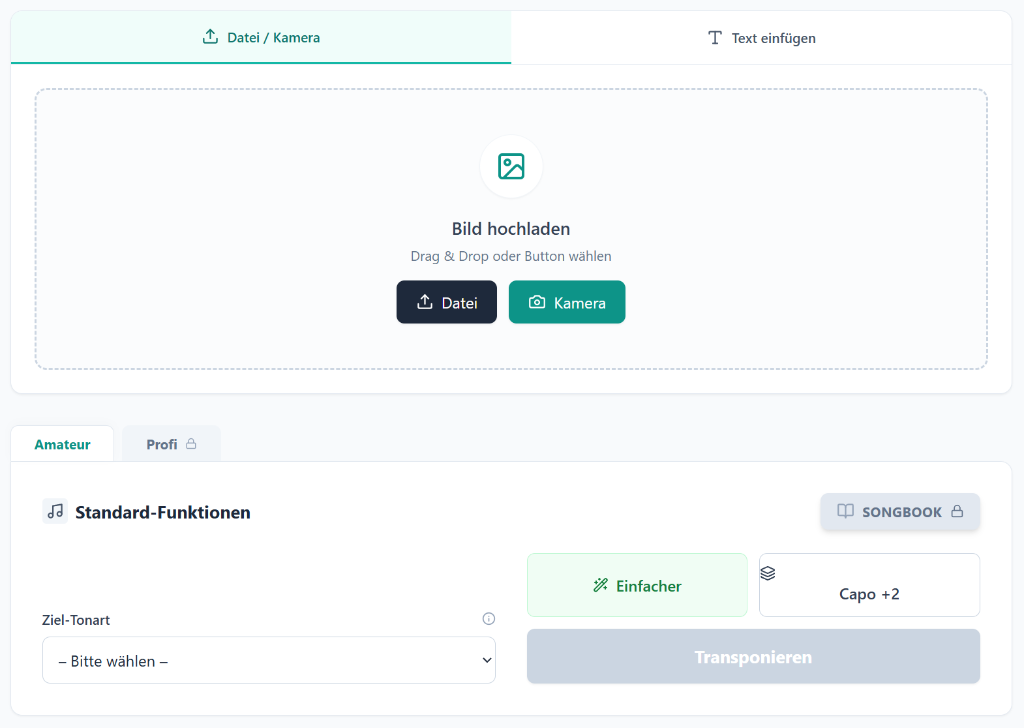
Transpose Your Chords Online Instantly
Whether your song doesn't suit your voice or the chords are too complex, our online chord transposer helps you find the ideal key in seconds. Perfect for beginners and pros alike, just enter your chords and select your desired key to get started.
Advanced Theory & Insights
Deepened knowledge for professionals. Analyzing nuances that beginners often miss.
Theoretical Foundations of Chord Transposition
Technological Tools for Chord Transposition
The Role of Chord Transposition in Composition and Improvisation
FAQ
?
How does an online chord transposer function algorithmically to accurately shift the key of a piece of music while maintaining the integrity and relative tonal relationships between the chords?
?
Why might a musician choose to use an online chord transposer as opposed to manually transposing music, and what specific advantages does this tool offer in terms of time efficiency and accuracy?
A musician might choose to use an online chord transposer rather than manually transposing music for several practical reasons. Firstly, **time efficiency** is a significant benefit; online tools can transpose music in seconds, while manual transposition can be a time-consuming process, especially for complex pieces or when dealing with multiple keys.
Moreover, an online chord transposer ensures **accuracy**. Musicians may occasionally make mistakes when shifting notes or chords, particularly under pressure or when working with unfamiliar music. These tools eliminate human error by providing instant, precise transpositions. This is especially beneficial for musicians who need to quickly adapt songs for different instruments or vocal ranges.
Furthermore, many online transpose tools allow for real-time adjustments and provide additional features, such as listening to the newly transposed music. This can aid musicians in finding the right key for performance or practice purposes.
For musicians looking to maximize efficiency and precision, using an online chord transposer is highly recommended. To get started, identify a reliable transposer tool, familiarize yourself with its features, and integrate it into your practice routine for seamless, professional results.
?
In what contexts, such as particular genres of music or performance situations, do musicians find online chord transposers to be the most beneficial, and how does this impact their ability to adapt songs for different instruments or vocal ranges?
Musicians find **online chord transposers** particularly beneficial in several contexts, including **live performances**, **jamming sessions**, and **studio recordings**. In these scenarios, the ability to quickly change the key of a song can accommodate different **vocal ranges** or adapt to the instrumentation available, ultimately enhancing the overall performance.
For example, during a live jam, a vocalist may need the song to be transposed to suit their vocal capabilities. Using an online chord transposer allows musicians to swiftly modify **chords and keys** on-the-fly, ensuring that all participants can comfortably play or sing together. Similarly, in studio settings where instrumentalists play various instruments, transposers facilitate seamless adjustments, making it easier to experiment with and find the desired sound while maintaining musical harmony.
To maximize the utility of online chord transposers, musicians should familiarize themselves with different **genres** and their typical **key signatures**. For actionable advice, try practicing with an online tool to transpose common songs into various keys, which can develop your adaptability and proficiency in different musical contexts. This goes a long way in ensuring that musicians are prepared for various performance situations.
?
How do user interface design and usability principles influence the effectiveness of an online chord transposer, and what features can enhance the user's experience and knowledge of music theory through its use?
User interface design and usability principles play a crucial role in the effectiveness of an online chord transposer. A clean, intuitive interface allows users to easily navigate through functionalities, minimizing the learning curve. For instance, using clearly labeled buttons and straightforward input fields for chord selection ensures users can transpose music quickly without confusion.
Additionally, incorporating features such as real-time transposition feedback enhances usability. Users should be able to see the transposed chords instantly, which aids in understanding the process. Including a visual representation, such as chord diagrams, can significantly enhance user comprehension and facilitate learning.
To further enrich the user’s experience and knowledge of music theory, consider integrating educational resources. For example, tooltips or a dedicated section explaining concepts like intervals and keys associated with different transpositions can empower users to grasp the underlying music theory. Interactive tutorials or quizzes can also engage users and provide practical applications of their learning.
Ultimately, focusing on clarity, immediacy, and educational support can transform a simple chord transposer into a valuable resource for users at all skill levels.
?
What are the challenges and limitations faced by online chord transposer tools in dealing with complex chord structures, and how do these challenges affect a musician's ability to accurately interpret and use the transposed chords in practice?
Online chord transposer tools serve as useful aids for musicians, but they face several **challenges** and **limitations**, particularly when handling **complex chord structures**. One major issue is that many tools rely on simplified algorithms that may not accurately address variations in chord voicing or alterations. For example, jazz or classical chords often incorporate extended notes and inversions, which basic transposers may overlook, leading to misrepresented chords.
Additionally, transposition can become problematic with **unusual tunings** or unusual song structures. This complicates the ability of the online tools to provide results that sound musically coherent. Furthermore, tools generally lack context for the song's style or the musician's intent, resulting in chords that may be technically correct but sonically unpleasing.
To better interpret and use transposed chords effectively, musicians should **manually review** transpositions, especially for complex pieces. It’s advisable to familiarize oneself with **music theory**, ensuring they can adjust or enhance transposed chords as needed. Musicians should also seek tools that offer **customization options**, allowing for adjustments based on genre and chord complexity.